
China Localization Legal Report Solution
Around China's localization regulatory requirements, SUREINFO provides integrated statutory reporting solutions from consulting and planning through implementation and operation. The solution focuses on preparing and delivering China statutory financial statements - covering local account mapping, reporting basis definition, and adjustment handling - issuing balance sheets, income statements, and cash flow statements in line with China Accounting Standards, with support for regulatory filing and audit, helping enterprises achieve consistent reporting basis and traceability (accuracy depends on source data quality).
Our China localization statutory reporting solution focuses on end-to-end capability across "consulting + delivery + operations" and provides implementable SAP localization for enterprises operating in China. From regulatory requirement identification, process blueprint design, and system configuration and development through go-live operation support, we help enterprises remain compliant and stable amid regulatory changes. As Chinese accounting and tax rules continue to evolve, running a foreign ERP such as SAP without a deliberate localization layer creates recurring filing risk that cannot be solved with spreadsheets alone.
The solution focuses on the preparation and output of China statutory financial statements, covering local account mapping, reporting basis definition, and adjustment handling, issuing balance sheets, income statements, and cash flow statements in line with China Accounting Standards, with support for regulatory filing and audit. By aligning finance and business data, it helps achieve consistent reporting bases and full traceability (accuracy depends on source data quality) — from the source ledger entry through every local adjustment to the final filed statement.
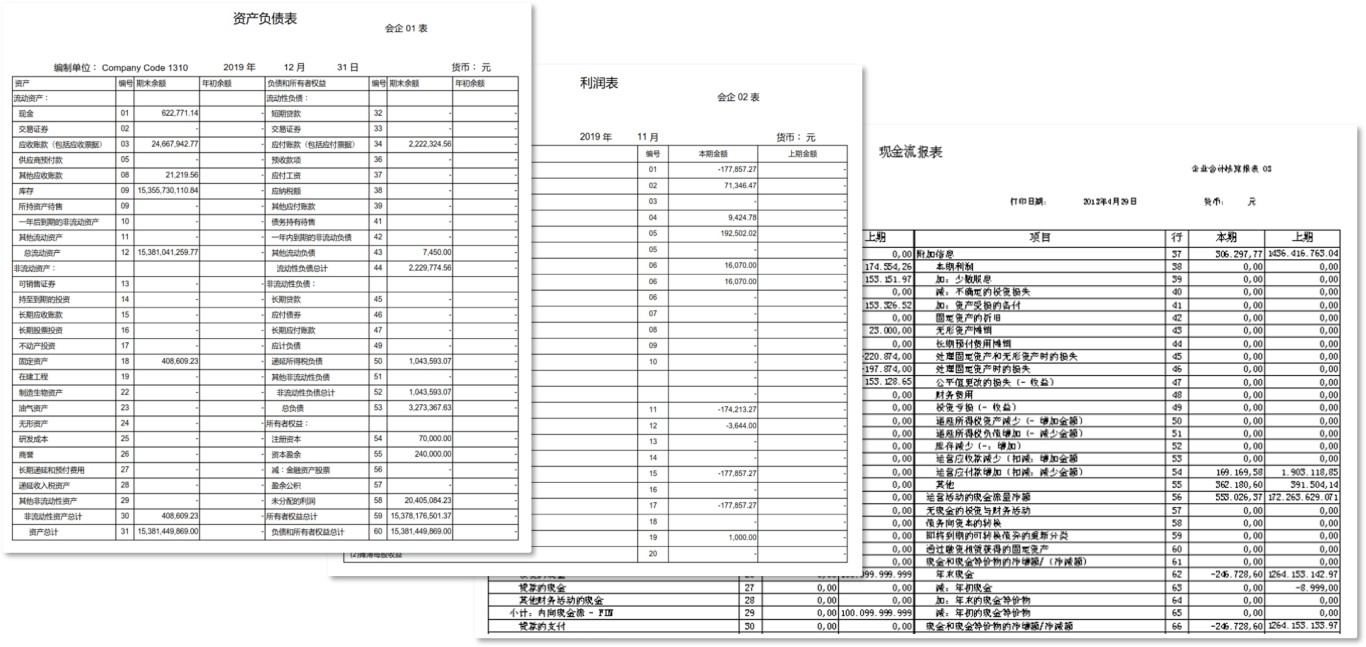
At the delivery level, SUREINFO provides a complete project methodology from requirements analysis, prototype validation, and integration testing through cutover and go-live, supporting both SAP ECC and SAP S/4HANA environments. Combined with industry characteristics and organizational structure, this forms a replicable, auditable, and continuously optimizable China localization solution that can be rolled out to additional legal entities without rebuilding from scratch.
For China's regulatory practice, the solution builds in local reporting templates and key control points, supporting monthly, quarterly, and annual statutory statement preparation and filing in line with China Accounting Standards and regulatory requirements, with automated validation to reduce the risk of manual adjustment and repeated review. Controls also cover VAT and invoice-related reporting entries, local tax registrations, and the parallel currency and ledger requirements that many group companies operate under.
Compliance pressure. Enterprises operating in China face a high filing frequency: statutory statements must be prepared and filed monthly, quarterly, and annually, and the reporting basis often differs from the group's IFRS or local GAAP consolidation. The differences arise in chart-of-accounts mapping, expense recognition, depreciation rules, and tax treatments, which means finance teams must reconcile two parallel sets of books every period. Auditors and regulators also demand full traceability from source ledger entries through local adjustments to the final filed statements, and they expect the same logic to be applied consistently across reporting cycles. Without a controlled system, this reconciliation consumes closing time, delays the month-end timetable, and exposes the company to misstatement risk during inspection, especially when key local-reporting knowledge sits with a small number of individuals rather than being embedded in the system.
Parallel reporting and consolidation. Most group companies run two reporting tracks in China: the local statutory ledger filed with authorities, and the group consolidation reported under IFRS or another corporate standard. Our solution maintains both from shared transactional data, using adjustment ledgers and mapping rules rather than duplicate manual entry, so the two reports reconcile to one another and group finance does not have to rebuild local numbers from scratch each cycle. This alignment also reduces the effort external auditors spend verifying local filings, because the adjustment trail is embedded in SAP instead of living in offline workpapers.
SUREINFO delivery methodology. Our engagement begins with a regulatory impact assessment that maps current processes against China Accounting Standards and the latest filing requirements, then defines gap closures in SAP configuration, local development, and master data. We run prototype validation using real trial-balance extracts so the business can review statement layouts and adjustment workflows early, followed by integration testing across FI, CO, asset accounting, and tax before cutover. After go-live we transfer operational ownership with a documented runbook, provide periodic updates as regulations change, and staff a support channel for filing-season questions. This combination of a documented blueprint, tested templates, and ongoing operational support keeps the solution compliant as Chinese accounting and tax rules continue to evolve, rather than leaving clients to react to each new circular and filing deadline under pressure.